A Miele évente kétszer, 55 ezer példányban megjelenő magazinja, a „zu Tisch" elsősorban a színvonalas gasztronómiai és kulturális élmények kedvelőit szólítja meg.
A magazin legfrissebb száma többek között ezekben a témákban ad hasznos tippeket.
A receptek, a művészet és a kultúra újszerű alkotásait tárgyaló írások mellett a magazin közkedvelt témája az egyes országok, régiók gasztronómiai kínálatának a bemutatása is.
A legutóbbi számban 4 oldalas, képekkel illusztrált összeállításban a Dél-Dunántúl borvidékeivel, a borokat övező hagyományokkal, kulturális programokkal ismerkedhettek az olvasók.
Többek között a Pécsett évente megrendezendő Európai Bordalfesztiválról és a Pécsi Bornapokról esett szó.
Assyrtiko, rkatsiteli, saperavi - mi a közös bennük?
08. 07. - 08. 08. 05. - 08.
PÉCSI BOROZÓ - Március 8-án országszerte megjelenik a Pécsi Borozó tavaszi száma, amely egyben az eddigi legtartalmasabb magazinunk, hiszen ezúttal 132 oldalon kínálunk olvasnivalót.
A Pécsi Borozó első száma 2008 tavaszán látott napvilágot, akkor elsősorban a Pannon Borrégió boréletére fókuszált a lap tartalma.
is hangsúlyozottan gasztronómiai és bormagazinként jelenik meg.
A Pécsi Borozó országszerte kapható az újságárusoknál, elsősorban a Relay és Inmedio kioszkokban, plusz elérhető a forgalmasabb benzinkutakon és hipermarketekben, valamint a dél-dunántúli Coop-boltokban.
Károly Kocsis (Editor-in-Chief)
2018. National Atlas of Hungary - Natural environment. Hungarian Academy of Sciences, Research Centre for Astronomy and Earth Sciences, Geographical Institute, Budapest.
A National Atlas of Hungary (MNA) was published first in 1967, then in 1989.
A new edition of the Atlas in four volumes in Hungarian and also in English wishes to present the dynamic spatial structure of nature, society and the economy not merely for Hungary, but wherever the required data are available, for the Carpatho-Pannonian Area.
A national atlas is the given country’s ’identity card,’ one of its most significant national symbols in addition to its flag, coat of arms and national anthem.
The volumes of the new Hungarian National Atlas are headed by an introduction to Hungary’s natural environment.
On the one hand, this publication gives an overview of the state of the lithosphere, hydrosphere and atmosphere, as well as of the biosphere in Hungary.
On the other hand, there are synthetic chapters and topics that analyse how the natural and human environments are interconnected and how they interact (e.g. landscapes, environment protection, nature conservation, and natural hazards).
Leafing through the thematic maps grouped together, we are informed about such diverse themes as engineering geology, earthquakes, expected changes in the elements of the climate, weather records, groundwaters, karstic, mineral, medicinal and thermal waters, the main features of soils, land quality, types and characters of landscapes, Hungary’s amazingly rich flora and fauna, the current state of the environment and waste management, protected areas, ecotourism, and the country’s main natural hazards, namely floods, excess waters, droughts, soil erosion, the spread of invasive species and pollen allergies.
On behalf of the several hundred contributors, let us express our hope that our esteemed readers inside and outside the national borders will enjoy the pleasures and benefits of browsing the printed book (despite its large size) or reading its digital version on the Atlas webpage.
Károly Kocsis (Editor-in-Chief)
2018. National Atlas of Hungary - Natural environment. Budapest, MTA CSFK Geographical Institute.
Kocsis, K. (Editor-in-Chief) 2018. National Atlas of Hungary - Natural environment. Budapest, MTA CSFK Geographical Institute.
Gábris, Gy., Pécsi, M., Schweitzer, F., Telbisz, T. 2018. Relief. In: Kocsis, K. (Editor-in-Chief): National Atlas of Hungary - Natural environment. Budapest, MTA CSFK Geographical Institute. pp.
Ed. Ed. Ed. Ed. Ed. Eds. Eds. Eds. Ed. Ed. Ed. Eds. (Budapest, April 1st 1889 - Budapest, October 7th 1956)
He was a portraitist, a fine art photographer, a master of his profession honoured with the „gold wreath” (the highest award of that time), specialist, teacher of his trade, art collector.
His pictorialist portraits, landscapes, - adverts that amalgamated the elements of new objectivity, still lifes, avant-garde nudes, and his new approach to portraits of people have all proved to be enduring and in many cases have inspired numerous followers.
He was born to a well-to-do Budapest middle-class family.
In 1903, he began his photography career as an amateur.
In addition to this, he painted portraits, often made drawings and played the bassoon and piano beautifully.
In 1906, he took an examination in business studies and between 1909 and 1911, he studied at the München academy of photography where he finished with distinction and received the (then) most prestigious German professional photography award, the Dührkoop medal.
We can therefore say that he had a flying start.
From then on, his pictures could be seen all over the world and all manner of prestigious acknowledgment and prizes came to his name.
In 1911 he received a gold medal in Rome and Moscow.
One year later, he attained the acknowledging diploma of the Association of International Professional Photographers’ V Parisian Congress.
Another year and he was chosen to be an honorary member of the Salon of Photography in London.
Numerous other cities honoured him for his pictures; Göteborg in 1929, Vienna in 1929 and 1934, Amsterdam in 1932 and Milano in 1934 where the World Exhibition of Applied Arts took place.
As well as his creative work, he also started to concern himself with passing on his knowledge.
If one day the history of Hungarian Photography is published, his name will be mentioned among the first there too.
On the charge of the capital city, he founded the photography section in the Budapest Arts and Craft School in 1913.
A long-standing problem was solved in this way: these (professional) photographers could get an organized education in their specialties.
The prize deserved for establishing the first photo school failed to be awarded this time, moreover in 1920 he had to stop teaching, for his left wing views and was rehabilitated only in 1946.
In 1911 he opened the first studio in Budapest and moved into his celebrated studio flat under No.8 Dorottya utca in downtown Budapest the interior of which was designed by Lajos Kozma, the most famous architect of the time.
Although he was not able to continue his teaching in an official capacity in a state school, he did not give it up.
In his studio there were always many students, among them those of aristocrat and upper middle-class descent, relatives of the staff of the foreign representations, and some among the photographers who became famous afterwards, such as Éva Besnyo, Éva Barta, Zsuzsa Pintér, Erno Vajda’s son and Lászlo Bruck.
In 1917 he organized an exhibition from the pictures of his students called Pupils’ Photographs.
He travelled to many places and collected 19th century French furniture, paintings and textiles with real expertise.
He became a well-known connoisseur of art.
It was still a pleasure to step into his salon even forty years after his death.
He was joined in marriage on November 1st, 1929 to Rozi Balázs, who appeared in the Photo und Publizitt advertisement book in the following year - which is the first volume on this theme, and the reprints are still bought everywhere in the world today - and she became one of his most-photographed models.
It is not an exaggeration to say that Pécsi was one of the artists who raised advertising photography to an art, who with his pictures created schools which still exist today.
Of course, it is possible to say that he was also the master without equal of portraits or nudes.
Clearly it is not by chance that the publication of the first nude portfolio was connected to his name.
He created portraits of famous people such as Béla Bartók, Lajos Kassák, Dezso Kosztolányi, József Egry, Pablo Casals, Anna Pavlova and Nizsinszkij, and much later he was even summoned to the party headquarters to take the portrait of Communist dictator Matyas Rakosi, when he turned 60.
The Deutsche Kunst and the English Studio published his works several times.
While he created excellent pictures in the new style of photography, he also carried off masterfully the refining techniques.
He wrote articles and held lectures on the art of oleographs (1928) and his refining techniques (1940).
In 1952 he patented the combined duplex pigment prints under the name PEJO.
If he was given a task for which he did not have the right equipment, he was willing to put together or alter cameras especially for that purpose.
His contemporaries thought well of him as well. They elected him deputy president of the Budapest Photographers’ Trade Organization and as the editor of the Magyar Fotográfia (Hungarian Photography) photographers’ professional editorial.
He became a gold-wreathed master from 1932.
The married couple fled to Nagyvárad from the Hungarian Nazis, where the police captain was Pécsi’s brother-in-law.
At the time of the siege of Budapest, in 1944/45, his studio in Dorottya utca burned down, and when they returned to Hungary in 1946 they only found only a fragment of their possessions, library, pictures and negatives.
From then on, Pécsi, a par excellence citoyen, did not - could not - find his place in a world that was declared even publically to be ideologically “anti-bourgeois”.
The last ten years of József Pécsi’s life heralded the glory of socialism that existed then.
This man, who between 1911 and 1940 earned seventeen grand prizes, among them five gold medals, five silver medals, diplomas and dozens of plaques, made his living from the creation of passport-sized photographs and portrait photos in his flat in Vámház körút (then known as Marshall Tolbuchin Boulevard).
In one of his letters, he asked for a used winter coat still in good condition from his former students living abroad.
After a long illness, he died aged 67.
There is a memorial plaque that commemorates his name at the entrance of his old studio at Dorottya utca 8.
Luckily reprints of his books and exhibitions of his work are appearing one after the other, and his place in Hungarian photography is secured.
Sources:Kincses Károly: Fotográfusok - made in Hungary. Akik elmentek / Akik ittmaradtak (Those who left/Those who remained)Hungarian Museum of Photography - Federico Motta Editore, 1998. 154-155.
Pécs ( PAYTCH, Hungarian: [ˈpeːt͡ʃ] ⓘ; Croatian: Pečuh; Slovak: Päťkostolie; also known by alternative names) is the fifth largest city in Hungary, on the slopes of the Mecsek mountains in the country's southwest, close to the border with Croatia.
A city dating back to ancient times, settled by the Celts and the Romans, it was made an episcopal see in early medieval Hungary.
It has the oldest university in the country, and is one of its major cultural centers.
Pécs has a rich cultural and architectural heritage stemming from 150 years of Ottoman rule, and it contains the largest number of Turkish Ottoman buildings found in any city in Central Europe.
It is historically a multi-ethnic city where many cultures have interacted through 2,000 years of history.
In recent times, it has been recognized for its cultural heritage, including being named as one of the European Capital of Culture cities.
The earliest name for the territory was its Roman name of Sopianæ.
The medieval city was first mentioned in 871 under the name Quinque Basilicae ("five cathedrals".)
The name refers to the fact that when constructing the churches of the city, the builders used material from five old Christian chapels.
Pécs is located in the Carpathian Basin of Central Europe, in the center of the southern Hungarian county of Baranya.
It is bordered by the Mecsek hills to the north, and by a rolling plain to the south.
Pécs has a significant mining past.
The city of Pécs is located near the border of Croatia.
Its southern part is rather flat whereas its northern part clings to the slope of the Mecsek mountains.
It has a very favorable climate, and is bordered by a flourishing woody area.
Pécs is bordered by plains to the south (elevation 120-130 m), while the Mecsek mountains rise up to elevations of 400-600 meters behind the city.
Jakab-hegy, located in the western Mecsek, is 592 m tall, Tubes, straight above Pécs, is 612 m tall, and Misina is 535 m tall.
Higher parts of the city climb up to 200-250 m, mainly Pécsbánya, Szabolcsfalu, Vasas and Somogy.
Woody areas generally start from elevations of about 300 m.
The Mecsek hills are marked by numerous valleys which play a key role in ameliorating the climate of the city in the absence of lakes and rivers.
The area has been inhabited since ancient times, with the oldest archaeological findings being 6,000 years old.
The city of Sopianae was founded by Romans at the beginning of the 2nd century, in an area peopled by Celts and Pannoni tribes.
The centre of Sopianae was where the Bishop's Palace now stands.
Some parts of the Roman aqueduct are still visible.
By the 4th century, Sopianae became the capital of Valeria province and a significant early Christian centre.
When Charlemagne arrived in the area in 791, it was ruled by the Avars.
According to György Györffy's theory of place names, after the Hungarians conquered the Carpathian Basin, they retained a semi-nomadic lifestyle, changing pastures between winter and summer.
Árpád's winter quarters - clearly after his occupation of Pannonia in 900 - were perhaps in Pécs.
Later, when the Comitatus of Baranya was established, the capital of the comitatus was not Pécs but a nearby castle, Baranyavár ('Baranya Castle').
Pécs, however, became an important religious centre and episcopal seat.
In Latin documents, the city was mentioned as Quinque Ecclesiae.
Around 1000, the area was inhabited by the Black Magyars.
The Roman Catholic Diocese of Pécs was founded in 1009 by Stephen I, and the first university in Hungary was founded in Pécs in 1367 by Louis I the Great.
Peter Orseolo, the second king of Hungary, was buried in the cathedral in 1046.
The location of his grave is unknown.
This is because the cathedral burnt down shortly after Pécs hosting the 1064 Easter celebrations by King Solomon, after him making peace with his cousin, the later King Géza I.
Several religious orders settled down in Pécs.
The Benedictine order was the first in 1076.
In 1181, there was already a hospital in the city.
During the Mongol invasion of 1241-1242, Pécs was devastated and burned to the ground.
Pécs Travel Guide 2026
King Louis I the Great founded a university in Pécs in 1367, following the advice of the city's bishop, William of Koppenbach, who was also the king's chancellor.
It was the first university in Hungary.
After the 1526 Battle of Mohács, in which the invading Ottoman army defeated the armies of King Louis II, the armies of Suleiman occupied Pécs.
Not only was a large part of the country occupied by the Ottomans, the public opinion of who should be the king of Hungary was divided, too.
One party supported Ferdinand of Habsburg, the other party crowned John Zápolya in Székesfehérvár.
The citizens of Pécs supported Ferdinand, but the rest of Baranya county supported John.
In the summer of 1527, Ferdinand defeated the armies of Zápolya and was crowned king on 3 November.
Ferdinand favoured the city because of the support of its citizens, and granted Pécs tax exemption.
In 1529, the Ottomans captured Pécs again, and went on a campaign against Vienna.
The Ottomans forced Pécs to accept King John (who was allied with them) as their ruler.
John died in 1540.
In 1541, the Ottomans occupied the castle of Buda and ordered Isabella, the widow of John, to cede Pécs to them, due to the city's strategic importance.
The citizens of Pécs defended the city against the Ottomans and swore loyalty to Ferdinand.
The emperor helped the city and defended it from further Ottoman attacks, but his advisers persuaded him into focusing more on the cities of Székesfehérvár and Esztergom instead of Pécs.
Pécs was preparing for the siege, but a day before, Flemish and Walloon mercenaries fled from the city and raided the nearby lands.
After occupying the city, the Ottomans fortified it and turned it into a truly Ottoman city.
The churches were turned into mosques, complete with minarets; hamams were built, Qur'an schools were founded, and there was a bazaar in place of the market.
For one hundred years the city was an island of peace in a land of war.
In 1664, Croat-Hungarian nobleman Nicholas Zrínyi arrived in Pécs with his army.
Since the city was well into the Ottoman territories, they knew that even if they occupied it, they could not keep it for long, so they planned only to pillage it.
They ravaged and burned the city but could not occupy the castle.
Mediaeval Pécs was destroyed forever, except for the wall encircling the historical city, a single bastion (Barbakán), the network of tunnels and catacombs beneath the city (partially closed down, and partially in possession of the famous Litke champagne factory, which can be visited today).
In the 1686 Siege of Pécs, the Austrian army finally recovered the city from the Ottoman Turks.
After wresting the castle of Buda from Ottoman rule, the Christian armies went on to capture Pécs.
The vanguard managed to break into the city and pillaged it.
The Ottomans saw that they could not hold the city, burnt it and withdrew into the castle.
The army led by Louis of Baden occupied the city on 14 October and destroyed the aqueduct leading to the castle.
The city was under martial law under the command of Karl von Thüngen.
The Viennese court wanted to destroy the city first, but later they decided to keep it to counterbalance the importance of Szigetvár, which was still under Ottoman rule.
Slowly the city started to prosper again, but in the 1690s two plague epidemics claimed many lives.
In 1688, German settlers arrived.
Only about one-quarter of the city's population was Hungarian, the others were Germans or Southern Slavs.
The census of taxpayers from 1698 lists 637 families, for which Janja Živković Mandić concludes that 308 were of Croatian nationality (Catholic Croats, Racs, Šokci, Bunjevci, Illyrians, Slavs, Bosniaks) and the remaining 329 were Hungarians, Germans, Serbs or Greeks.
According to same census, István Tabo mentions 171 Hungarian, 349 Slavs and 79 Germans while Đuro Šarošac mentions that at that time in the city lived 325 Croats, 139 Hungarians, 92 Germans, 53 Vlachs and 28 Serbs.
According to 1698 data, South Slavs comprised more than half of the town's population.
A more peaceful era started after 1710.
Industry, trade and viticulture prospered, manufactories were founded, a new city hall was built.
The feudal lord of the city was the Bishop of Pécs, but the city wanted to free itself from episcopal control.
Bishop George Klimó, an enlightened man (who founded the first public library of the country) would have agreed to cede his rights to the city, but the Holy See forbade him to do so.
When Klimó died in 1777, Queen Maria Theresa quickly elevated Pécs to free royal town status before the new bishop was elected.
In 1785, the Academy of Győr was moved to Pécs. This academy eventually evolved into a law school.
The industry developed a lot in the second half of the 19th century.
By 1848, there were 1,739 industrial workers.
Some of the manufactures were nationally famous.
The iron and paper factories were among the most modern ones of the age.
Coal mining was relevant.
A sugar factory and beer manufactures were built, too.
After the Austro-Hungarian Compromise of 1867 Pécs developed, like all the other cities and towns of the country.
From 1867, Pécs is connected to the nearby town Barcs by railway, and since 1882 it is also connected to Budapest.
At the end of World War I, Baranya county was occupied by Serbian troops, and it was not until August 1921 that Pécs could be sure that it remains part of Hungary.
During World War II, Pécs was captured by Soviet troops of the 3rd Ukrainian Front on 29 November 1944 in the course of the Budapest Offensive.
The city suffered only minor damages, even though a large tank-battle took place 20-25 kilometres south of the city, close to the Villány area late in the war, when the advancing Red Army fought its way towards Austria.
Until the end of World War II, the majority Inhabitants was Danube Swabians.
A history of Hungary from 1945-1990, "under Soviet domination" can be found in A Concise History of Hungary.
After the war, development became fast again, and the city grew, absorbing several nearby towns.
Pécs was also the centre of the Nordic Support Group (NSG) consisting of units from Denmark, Norway, Sweden, Finland, and Poland, as part of the IFOR and later SFOR NATO deployments, after the Dayton Agreement and following peace in former Yugoslavia; the first units were deployed to Pécs in late 1995 and early 1996.
In 2010, Pécs was selected to be the European Capital of Culture alongside Essen and Istanbul.
The city motto is "The Borderless City".
Zsolnay Museum.
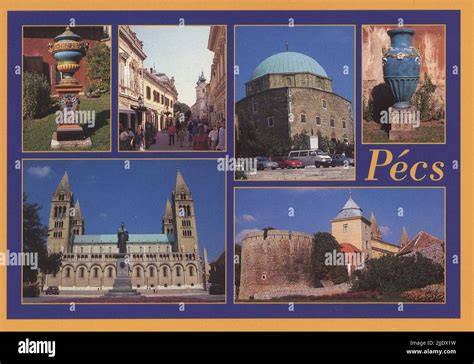
A good example of the city's history and interesting past can be seen in the main square, where the Gazi Kasim Mosque still stands, and, although consecrated as a church following the retreat of the Ottoman Turks centuries ago, the crescent moon of Islam is still visible on the cupola, surmounted by a cross.
Indeed, Pécs is the richest town in Hungary in terms of Turkish architecture, with the ruins of Memi Pasa's Baths and the mausoleum of miracle worker Idris Baba, just two other notable remains.
The Yakovalı Hasan Paşa Mosque, dating from the mid-1600s, still functions as an active mosque today.
University of Pécs (1367), building of the Faculty of Science and Faculty of Humanities in Ifjúság street.
Klimo Library (1774).
The mosque of pasha Qasim (1543-1546).
Originally gothic Church: St. Downtown (Houses from the Middle Ages.
The majority of the citizens with 84.0% are Hungarians according to the 2011 census.
The city's Germans are the largest minority with 4.2%.
The largest religious group is the Catholics with 39.7% Roman Catholic and 0.3% Greek Catholic.
The second largest denomination is the Calvinists (5.2%), the third the Lutherans (1.3%).
Pécs's climate is classified as humid subtropical climate (Köppen Cfa).
Among them, the annual average temperature is 11.5 °C, the hottest months are July and August with 30.0 °C, and the coldest month is January with 0.4 °C.
The annual precipitation is 670.9 millimetres, of which June is the wettest and January the driest.
Historically Pécs was well known in Hungary for its industry with several factories, but after the fall of the Iron Curtain many have not managed the economic transition well and went bankrupt.
The nationally famous porcelain factory, the Zsolnay Porcelain is the greatest pride of Pécs.
The Pécsi Sörfőzde (Pécs Brewery) is one of the four main Hungarian breweries, but the only one owned fully by Hungarians.
The Biokom waste management and recycling company is responsible for the transport and recycling of waste in the whole territory of Pécs and the surrounding areas.
The energy used in the settlement is produced mainly by the two biomass power plants of Pannonpower which consists of a 49,9 MW woodchip-fired and a 35 MW agricultural by-product-fired powerplants.
The country's largest solar cell field is also in Pécs, thanks to the city's southern location and longer sunny hours, which can produce about 10 MW energy a year.
The University of Pécs was founded by Louis I of Hungary in 1367. It is the oldest university in Hungary, and is among the first European universities.
In the recent past it used to be divided in two universities, one for Medicine and Orthodontics (POTE) and a larger one for other studies: JPTE (Janus Pannonius Tudományegyetem).
The POTE (Pécs University Medical School, now known as the Medical School) has a large English program for general medicine and dentistry and a new German program.
On 1 January 2000 these universities were combined under the name University of Pécs (acronym: PTE - Pécsi Tudományegyetem - University of Pécs).
The M6/M60 motorway connects Pécs and Budapest with the driving time between the two cities taking about 2 hours now.
The entire route opened on 31 March 2010. Route 6 crosses the city giving it an east-west axle and leaves it towards Barcs by the Croatian border.

A new airport opened in Pécs Pécs-Pogány International Airport in March 2006.
↑ OECD - FUNCTIONAL URBAN AREAS IN OECD COUNTRIES: HUNGARY
1 2 3 4 Detailed Gazetteer of Hungary.
Slovenská reč: časopis pre výskum a kultúru slovenského jazyka. 1998.
A filoxéravész előtt kadarka bora volt a leggyakoribb (noha messze nem a leghíresebb), de a XX. századra már hagyományosan fehérbor termelő vidékké vált.
A Mecsekalja leggyakoribb szőlőfajtája ma az olaszrizling, utána a chardonnay, a királyleányka és a rizlingszilváni.
Jelentősebb mennyiségű még a zöld veltelini.
A meleg éghajlatnak és a kevés csapadéknak köszönhetően a vidék borai általában testesek, gyakran magas cukor- és alkoholtartalmúak.
A félszáraz-félédes borokat kedvelők számára ez az egyik legfontosabb magyarországi termőterület, - egyelőre inkább csak hordós kiszerelésben -.
A viszonylag magas cukortartalmat lágy savak egész palettája kíséri, így biztosítva a bor belső egyensúlyát.
Gyakori a gazdag fűszeresség.
Ma már alig beszerezhető híres bora volt a Pécsi Cirfandli.
A fajta feltehetőleg Ausztriából származik.
Jellegzetesen mezei virág illatú, sokrétegű, fűszeres zamatú ital.