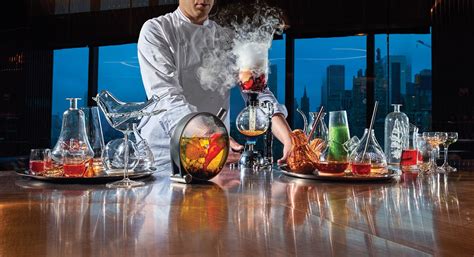
There’s no denying the excitement of posting up at The Aviary in Chicago for a cutting edge, futuristic cocktail experience.
The drinks are capable of bringing sheer satisfaction to the table by way of stellar ingredients and interactive components (aka glass portholes and ice spheres and slingshots).
Wow-factor cocktails will always be sought after-for obvious reasons-but as of late, bartenders and mixologists are prevailing with simple, no frills cocktails.
New education and a bevy of quality spirits brands are disrupting the market, making consumers think twice about what’s actually in their glass.
Essentially, cocktails are going through a “makeunder” revolution.
"The days of specialized bars for cocktails is dwindling and people are expecting good drinks at most, if not all, restaurants, clubs, and bars.
With that expectation, I feel there is less pressure to do something outlandish and more emphasis growing on efficiency and guest satisfaction-and at the end of the day people want to feel taken care of, not alienated.”
Some simple cocktails like the old-fashioned, the martini, and the cosmopolitan are making a comeback after becoming famous on shows such as Mad Men and Sex and the City.
“Among bartenders we are finding the beauty in these simple drinks again," Howard says.
“With people like Naren Young at Dante [in New York City] and Jacques Bezuidenhout at Wildhawk [in San Francisco] taking drinks like the martini and championing them we are getting further education on the idea of beauty in simplicity-plus I think people enjoy the idea of looking like Roger Sterling from Mad Men."
Bob Peters, mixologist at The Punch Room, at the Ritz-Carlton, Charlotte, will be the first to tell you that while his cocktails look extra fancy, he typically leans towards fewer ingredients.
“Editing recipes down to truly showcase just a couple beautiful ingredients is the cocktail equivalent of an acoustic set from your favorite band-there are no distractions, just purity and clarity of flavor,” Peters says.
“I think the trend of simple cocktails is a natural swing of the pendulum that travels back and forth many times when you look at the big picture.
I think that a part of progress sometimes is simplifying things.”
While the spirits industry has boomed drastically over the past decade, not all products are created equal.
In the past, a number of ingredients were used in a cocktail to hide the taste of a spirit.
“There was a time in our history where the alcohol we created was completely unpalatable and we needed to ‘cover it,’ if you will," says Azrhiel Frost of Chicago’s Baptiste & Bottle.
“We have educated ourselves, we’ve experimented, and we’ve discovered better-quality ways of producing beautifully distilled products that speak for themselves-that don’t need to be covered with anything.”
Consumers today are also becoming more educated; the same people who want to know the farm-origin of their meat also want to know how their spirits are made.
“With that comes a demand for better product and more of it,” Howard says.
“The shift towards fewer ingredients is greatly aided by this and now people want to taste the base spirit within cocktails,” prompting the experts behind bars to push the envelope.
“Now that consumers don't just want a drink where you can’t taste the alcohol, we are able to let the flavors found within the base spirit shine and do things to bring the flavor of the spirit forward or complement it-not cover it up.”
“I’ve personally observed an inundation of the over complication of a cocktail,” Frost says.
The reality is, “you can just put gin and vermouth in a glass and it will taste amazing.”
It’s more about quality over quantity nowadays, too, and bartenders actually caring about what goes in to consumers’ drinks.
In Greenville, South Carolina, Crafted at Nose Dive’s head mixologist Walker Pickering notes that “a cocktail is lot like a relationship-the less complicated it is, the more enjoyable it will be.”
Lately, he’s been focusing on using oils of fruit rinds instead of juice, which elevate drinks with flavor and smell simultaneously, while eliminating the need for an extra liquefied ingredient.
Plus, the end result is a fresh, aromatic taste.
Pickering is most excited about the Gene Hackman for fall-a cocktail composed of three ingredients (four if counting garnish): Larceny Bourbon, Bénédictine, Cynar, and a twist of lemon.
It’s simple, yet so striking when the spirits combine.
In Charlotte, Peters is enthusiastic about East to West, crafted with High West Double Rye, Krupnikas (a spiced honey liqueur made in North Carolina) and Ferris Wine (a fortified red wine produced in North Carolina), complete with a lemon rind garnish.
“It's one of the most popular cocktails right now at The Punch Room-simply delicious,” he adds.
At Henley, Howard perfects a Scotch-based Sazerac style drink for fall called Social Darwinism-crafted with Dewar’s, Clear Creek Pear Brandy, vanilla clove sweetener, sorghum vinegar, and rinse of Becherovka (an herbal liquor).
“The smoky quality of the scotch is the foundation for some fall flavors of ripe pear, vanilla, clove, and sorghum vinegar to keep the drink it the bright light place we look for to pair with chef RJ Cooper’s food-then the spiced aroma of Becherovka coats the glass for added dimension.”
The fast-paced nature of technology today might partly explain the new "less is more” mentality, the head bartender at New York City's Empire Diner Jenny Castillo suggests.
“No one wants to read a cocktail menu that has eight ingredients per drink.
Final Sale.
In stock online.
A super-chic collection of 150 classic cocktail recipes created by one-time Vogue drinks expert and man about town, Henry McNulty.
The Little Black Dress of cocktail books.
From the archives of British Vogue, the classic cocktail book, for a new generation of discerning drinkers.
Vogue Cocktails is an exquisite collection of recipes compiled by former British Vogue drinks aficionado and man-about-town, Henry McNulty.
Taking inspiration from the cocktail culture of the 1930s, Vogue Cocktails contains 150 delectable recipes organized by base spirit - Champagne, Gin, Vodka, Whisky, Rum and Brandies & Other Spirits - to ensure a drink for every palate.
Henry McNulty was born to American parents in China in 1913.
He returned to the States for his education and became a war correspondent during World War II, which took him around Europe and gave him the opportunity to gather observations on the drinking habits of different countries.
He began working for the drinks industry in the 1950s as a PR consultant, later progressing to a career in drinks journalism.
Henry wrote for publications including House & Garden and Gourmet before landing a regular wine and spirits column in Vogue, some of which were abridged for the first edition of Vogue Cocktails.
He also authored Vogue A-Z of Wine, One for the Road (a guide to non-alcoholic drinks) and Drinking in Vogue.
Henry came to be considered as a trusted authority on drinks and a cocktail aficionado.
Vogue is an internationally prestigious luxury brand with an estimated international readership of 12.5m.
It’s been a big fall for Greta Lee, who has only doubled down on her fashion bona fides by stepping out Diotima, Eckhaus Latta, Colleen Allen and other quintessentially New York brands to promote Tron: Ares, Late Fame, and A House of Dynamite in recent weeks.
Now, to celebrate her first Vogue cover, Lee has enlisted the help of her friend Don Lee, a bar consultant, to mix up six different cocktails inspired by her six favorite movies.
First up? A Bokbunja Yuja Sour, based on the 2003 film Memories of Murder by South Korean filmmaker Bong Joon Ho, which Lee says made her feel “understood” when she saw it for the first time.
The second cocktail in her rotation? The Yellow Last Word, inspired by the 1994 Wong Kar-wai film Chungking Express, which includes less gin thank you’d think (although Lee is extremely down to freestyle with her mixology).
“I feel weird drinking alone! Do you want one too?” Lee asks Don, who politely demurs before helping her to stir up the night’s third drink: a tiki-derived Painkiller, inspired by Baz Luhrmann’s 1996 film Romeo + Juliet.
(This one includes pineapple-infused rum, caramelized coconut, and a healthy helping of rum.)
As for the other three drinks (and films) in Lee’s lineup? You’ll just have to watch the video for yourself to find out what those are.
(After all, if you can’t hang out at a bar until the wee hours with Greta Lee IRL, this isn’t a bad alternative.)
Director: Nina Ljeti
Director of Photography: Cory Fraiman-Lott
Editor: Evan Allan
Senior Producer: Bety Dereje
Associate Producer: Lea Donenberg
Assistant Camera: Austin Smoak
Gaffer: John Izarpate
Audio: Andrew Kim
Production Assistant: Yirssi Bergman
Stylist: Danielle Goldberg
Stylist Assistant: Lillian Warner
Tailor: Hailey Desjardins
Greta Lee wears Colleen Allen.
Hairstylist: Jenny Cho
Makeup Artist: Nina Park
Makeup Artist Assistant: Nanase Ito
Production Coordinator: Tanía Jones
Production Manager: Kristen Helmick
Line Producer: Natasha Soto-Albors
Assistant Editor: Justin Symonds
Post Production Coordinator: Holly Frew
Art & Graphics Lead: Léa Kichler
Audio Mix: Nick Cipriano
Supervising Editor: Kameron Key
Post Production Supervisor: Alexa Deutsch
Entertainment Director: Sergio Kletnoy
Executive Producer: Rahel Gebreyes
Senior Director, Video: Romy van den Broeke
Senior Director, Programming: Linda Gittleson
VP, Video Programming: Thespena Guatieri
Filmed on Location: Fouquet’s New York
How Taylor Swift Inspired Greta Lee After Starring in "Opalite" Video | E! News
Emma Specter is the Culture Writer at Vogue, where she covers film, TV, books, politics, news, and (almost) anything queer.
She has previously worked at Garage and LAist and has freelanced for outlets including The Hairpin, Bon Appetit, them, The Hollywood Reporter, and more.
Her first book, More Please: On ...
| Trend | Példa |
|---|---|
| Egyszerűsítés | martini, old-fashioned, Gene Hackman koktél |
| Alapanyag fókusz | minőségi szeszek, gyümölcshéj olajok |
| Vogue hatás | Vogue Cocktails könyv, Henry McNulty |